Here is my final sound recording, I believe I have successfully created and merged the right sounds together that reflect the type of mood and atmosphere you would expect when looking at this image. I have considered time and space and attempted to recreate a quite surreal atmosphere inside and outside. If given the opportunity to do this again I probably would try and create a lot emotion through dialogue during inside the diner, also consider life in 1942 a lot more. Through the tutorials I can honestly say that I have learned a whole lot about sound, its such a remarkable element with boundless opportunities, its something that I definitely need to improve upon and perfect.
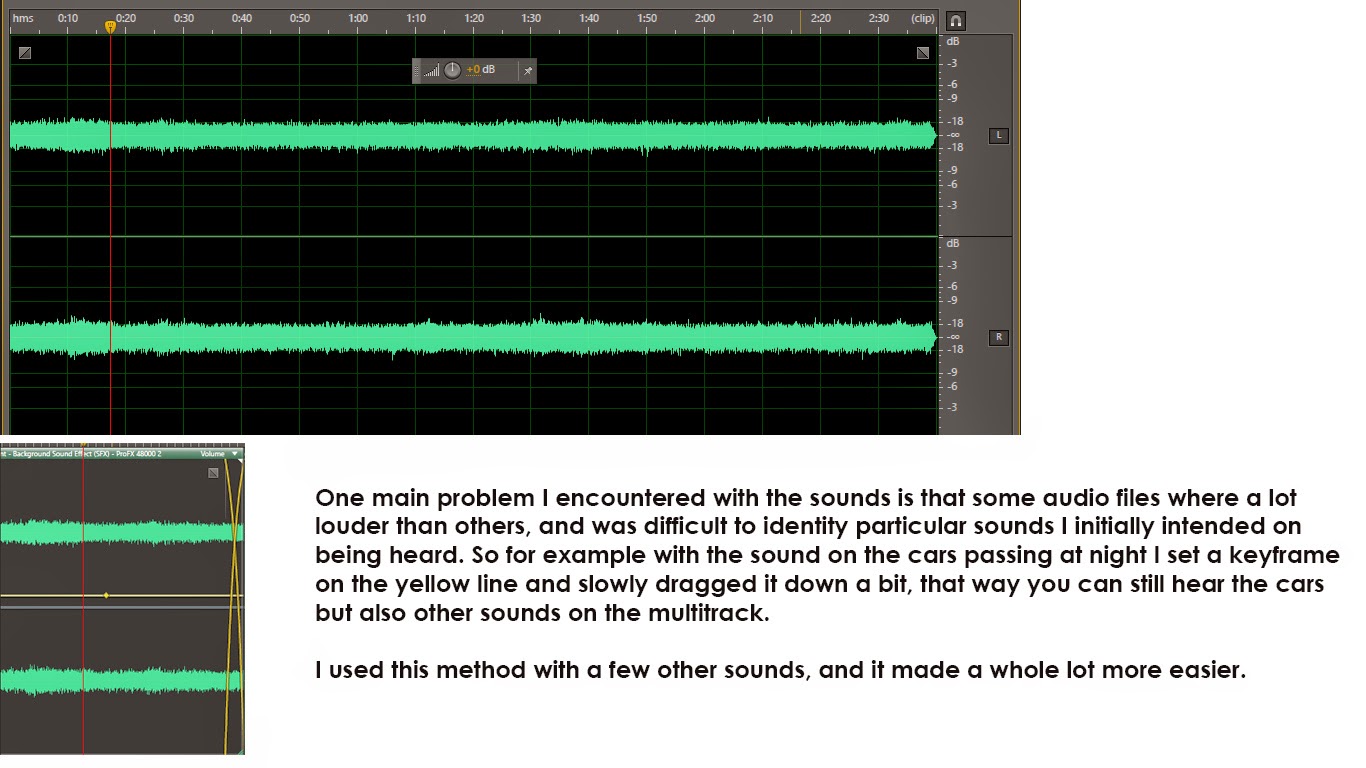
When layering different sounds together I wanted to make sure that they can smoothly transition in and out to to the point where you don't even realize the transition, because at first the way I layered the sounds
I decided to just keep my idea simple and just re-enact the sounds you would expect when viewing the image, to make it more authentic I wanted to incorporate sounds you may expect to hear in the 1940's. So I stumbled across a man called Arthur Tracy
Arthur Tracy was an American vocalist, billed as The Street Singer. His performances in theatre, films and radio, along with his recordings, brought him international fame in the 1930s. I looked online and found radio broadcast Arthur Tracy did in 1942.
I thought this would be a perfect fit to compliment my sound more and make it sound a lot more realistic. One piece of advice I gained which was extremely helpful was to always refer back to the image, which is something I never did before, which reflected in my first attempt. Below I have a few sounds I recorded, some I used and others I was just experimenting with different things for example sounds I used with my mouth and other objects.
We decided to record a few sounds for our experimental sound project and also a few sounds for film. The day was mostly spent experimenting with whatever we can find and seeing what sound we can create. The picture below shows a few examples of things we used to make different sounds for example in the first image we used the screen to recreate a heart beat, in the third image we found the thumping sound the door makes when closed quite interesting so we also recorded that.
One thing I didn't consider when recording is creating my own sounds, by using my mouth and hands. That's definitely one thing I am going to do when I use the recording studio.
Sound we experimented with by using various different objects
After presenting my findings and ideas to Simon and Joe, they both agreed that I provided good background research and information about the Nighthawks image. However it was evident that I did not decide on a solid Idea to work on, I proposed a few ideas a few narratives that I considered developing further.
I have decided that for my sound project that I am interpret the image which was set in 1941 into a modern day sound.
Tutorials To help me better understand Adobe Audition and some of its functions I took a look at some tutorials online that I found quite helpful, one in particular from a man called Mike Russell who does online video tutorials about using Adobe Audition.
I've had an idea for my experimental sound project where I want to take the listeners on a journey through time. Firstly I want to play sound's you would usually expect to hear in this picture which is set in 1942, then transition into sounds of the modern day world.
I accidentally discovered the sound of what happens when you move headphones too close to the audio recorder and figured its a sound I could possibly use, it reminds me of the sound when your tuning an old radio to find the right station, and the sound of interference. I also gathered and recorded some audio for atmosphere and environment. I recorded this in the library and I wanted to try and get the sounds of people talking laptops being used and the sound of keyboard's. Luckily in the beginning I got a quick sound of someone receiving a message on there phone which hep's portray the sound of the modern day.
So I opened up Audition and started layering the different audios I recorded to see what it would sound like, I noticed I quite a bit of wind which is something I need to bew
This is an attempt in trying to create a story in which someone is walking in to the diner (Nighthawks)
This did not come out as I would of hoped it would have, when Joe heard this he expressed a very good point which really helped me he said ' when listening to the sound always keep looking back at the image' I would get so caught up the what I want it to sound like that I completely forgot it needs to match the image. This something I must take under consideration and improve upon I'n order to be a lot more experimental I'm going to take these audio recording's and attempt to manipulate and distort the sounds. Also I have booked out an audio recorder so I will trying to record a lot more sound and physically creating my own sound to fit different purposes.
During Fridays experimental sound lesson we covered compression dynamic range, and exporting sound.
Single-band Compressor effect
Single-band Compressor effect reduces dynamic range, producing consistent volume levels and increasing perceived loudness. Single-band compression is particularly effective for voice-overs, because it helps the speaker stand out over musical soundtracks and background audio.
During the session I couldn't quite understand some of the topics mentioned so I viewed a few tutorials
Mixing
By automating mixes, you can change mix settings over time. For example, you can automatically increase volume during a critical musical passage and later reduce the volume in a gradual fade out.
Effects
We also looked how we can apply different effects to our audio.
Edward Hopper said that Nighthawks was inspired by "a restaurant on New York's Greenwich Avenue where two streets meet," but the image, with its carefully constructed composition and lack of narrative, has a timeless quality that transcends its particular locale. One of the best-known images of 20th-century art, the painting depicts an all-night diner in which three customers, all lost in their own thoughts, have congregated. Fluorescent lights had just come into use in the early 1940s, and the all-night diner emits an eerie glow, like a beacon on the dark street corner. Hopper eliminated any reference to an entrance, and the viewer, drawn to the light, is shut out from the scene by a seamless wedge of glass. The four anonymous and uncommunicative night owls seem as separate and remote from the viewer as they are from one another. Reworked and parodied countless times, Nighthawks has become an icon of American culture.
Artist: Edward Hopper
Completion Date:1942
Style:Social Realism
Genre:cityscape
Technique:oil
Material: canvas
“unconsciously, probably, I was painting the loneliness of a large city.”
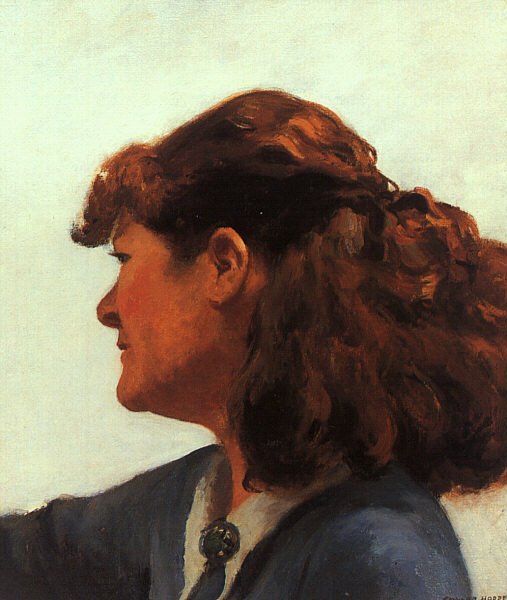
The four anonymous and uncommunicative night owls seem as separate and remote from the viewer as they are from one another. The red-haired woman was actually modeled by the artist’s wife, Jo.
A painting of Edward Hooper's Wife Jo
In order to help understand and interpret this image I wanted to look at how other people assess what they see and what they get out of looking at this image, so I found these two video's that I found quite helpful. It helped my get in to the right mind frame of this image and help identify key themes which I could then express through sound, such as loneliness isolation and silence.
Edward Hopper, Nighthawks, 1942
My reaction to viewing the image
When observing the image I gain a sense of mystery and concern, It seems pretty late in the evening and you have these four individuals sitting in what appears to be a diner. What are they talking about? why is the man and the women sitting together and yet the other person is seated further away? These are just a few of many questions which rush through my mind when looking at this Edward Hooper painting. The colors used in this painting create a very dreary and depressing feel to it, perhaps the use of the greens and blues helps set the atmosphere and tone of the scene. And yet in the picture you have this one dash of red which catches your eye, with the young women seated beside you gentlemen wearing the navy suite. Perhaps there is a reason why she is in red, red is the color of fire and blood, so it is associated with energy, war, danger, strength, power, determination as well as passion, desire, and love. One thing I can definitely say is that this image provokes thought and discussion, It forces you to create an opinion, the lack of information given in the image creates numerous possibilities of what could be happening in that image and why.
From this I intend experimenting with different sounds which I can incorporate and also explore different possibilities in which sound can manipulate emotion.
During this session of our experimental sound workshop on the 7th of February we focused on location recording, and discussed the importance of sound with footage. A few examples of sound artists which we have looked at are
Darren Hayman & Dan Mayfield http://lidomusic.blogspot.co.uk/
Chris Watson http ://www.chriswatson.net/downloads.html
We also explored various different microphones and the purpose in which compliments them best.
Condenser microphones
SHURESM57
AKGC414
MicrophoneTypes
• Condenser(Electret)
– Highlyresponsive
– Crispsound
– Delicate
Dynamic
– Sturdy
– Copeswellwithloudsounds
We were given these microphones to go out and create our own field recordings
One thing I learned from recording is that you can pick up a lot of wind that can distort the sound a bit.
On Fridays lesson we were introduced to the sound recording room, we learned how to operate the equipment. When creating and recording audio there are 4 screens one which monitors the room in which you record another screen is used to manage the audio levels, the one beside that one contains the pro tools software which allows you to edit your sounds, and the lastly the final screen is used to provide visuals to the sounds that you are trying to record, this screen in fact is synced with another screen in the recording booth which allows people in the booth view the footage.
We were given some video footage
We were the task to try and create the sound of the lamp moving, there is a room next to the recording booth which contains various different items which create their own sounds and noises. At first we found it a bit difficult trying to find an object that we can use to recreate the sound of the lamp moving, but we eventually used the sound of a metal lamp hitting a plank of wood. While in the booth with the use of the headphones we can communicate with the other who were operating the sound recording equipment, it took us a few takes to get it right but we accomplished it and it sounded pretty convincing.
One important lesson I learned form that day is that you can create sound from literally anything at first i didn't even realize that we could of just used our mouths to create a certain, but the possibilities are endless when creating audio that actually sounds convincing when accompanied by the visual




.jpeg)


